Category: Business, Marketing & Entrepreneurship

Insights on branding, digital strategy, business growth, and entrepreneurship, connecting research to practice.

  • Best Indexing Databases for Academic Career Advancement

    Research Publication Portal

    Targeting Career Advancement? Submit Your Research Today

    Submit your manuscripts to premier indexing databases and journals structured specifically to maximize academic tenure and professional promotion criteria.

    What Are the Most Reputable Indexing Databases I Should Submit My Research To for Career Advancement?

    For academic researchers, lecturers, and post-graduate scholars, publishing empirical studies is a core prerequisite for career advancement, tenure review, and professional promotion. However, the weight assigned to a publication depends almost entirely on the indexing reputation of the database where the journal is archived. Submitting to unverified outlets can stall career milestones, whereas targeting high-reputation databases accelerates academic credibility.

    Building upon our ongoing series covering academic publishing rates, open-access cost models, and general indexing services, this guide identifies the premier indexing databases that university evaluation committees and global institutions rely on for career progression.

    1. Career Impact Comparison of Major Indexing Databases

    Evaluating database tiers helps researchers align their manuscript targeting with institutional promotion boards and international academic standards.

    Indexing Database Tier Primary Evaluation Metric Institutional Recognition Career Benefit for Researchers
    Scopus & Web of Science (WoS) Citation impact factors, h-index, and peer-review rigor. Universal (highest tier for international universities and promotion boards). Essential for professorial promotions, grant approvals, and tenure evaluation.
    DOAJ & Regional Index Networks Editorial transparency, open-access compliance, and peer review. Strong across developing regions and specialized academic institutions. Certifies ethical publishing standards and ensures discoverability without predatory risks.
    Google Scholar & Repositories Full-text web indexing and automated author citation counts. Universal baseline for academic visibility. Provides immediate citation tracking and global reach for early-career scholars.

    2. Key Criteria for Career-Boosting Publications

    To satisfy rigorous promotion committee requirements, researchers must look beyond simple journal acceptance and examine structural indexing credentials.

    Database Recognition

    Ensure your target journal is indexed in recognized bibliometric databases explicitly valued by your institution’s promotion guidelines.

    Peer Review Transparency

    Committees favor double-blind peer-reviewed articles that demonstrate strong methodological rigor and verifiable editorial standards.

    Persistent Identifier Standards

    Journals must assign permanent DOIs and maintain clean XML metadata to feed citation metrics accurately into your professional profiles.

    Citation Interoperability

    Properly indexed publications seamlessly synchronize with ORCID, ResearchGate, and Google Scholar to display your cumulative research impact.

    3. The 3-Step Strategy for Career-Focused Submission

    Approach your publication pipeline strategically to maximize academic merit and satisfy institutional promotion mandates.

    1. Audit Institutional Criteria

    Review your university’s specific promotion guidelines to identify which database tiers and journal metrics carry the highest weight.

    2. Verify Indexing Claims

    Cross-check target journals directly inside official database directories before submission to avoid predatory traps that invalidate career points.

    3. Leverage Structured Portals

    Submit through professional publishing initiatives like Evans Consulting Publications that prioritize index-ready formatting and rigorous peer review.

    Career Promotion Pro-Tip

    Always maintain an updated ORCID and Google Scholar profile linked to your published DOIs so promotion committees can verify your citation metrics instantly.

    Frequently Asked Questions

    Which indexing databases are most heavily weighted for academic promotions?

    Scopus and Web of Science are universally recognized as the primary benchmark databases for professorial tenure and career advancement across most global universities.

    Can publishing in open-access journals hurt my academic career?

    Not if the journal is indexed in reputable databases like DOAJ or Scopus. The career risk arises only when publishing in unverified, predatory open-access mills that lack peer review.

    How do I prove my publication’s indexing status to a university promotion committee?

    Provide the official journal link, the permanent DOI, and a direct database search report showing the journal actively indexed within recognized academic directories.

    Author Account

    Track Your Career Publications in Your Publisher Dashboard

    Monitor your manuscript review milestones, manage index-ready metadata, and secure your publication records from your secure author account.

  • Business & Management Journals: Targeting & Publishing Guide

    Research Publication Portal

    Ready to Publish Your Business Research? Submit Your Manuscript Today

    Transition from corporate case studies, empirical regression models, and management frameworks to international peer-reviewed visibility.

    Business & Management Journals: Targeting and Publishing Your Strategy Research

    Publishing research in top-tier business and management journals requires a distinct approach compared to pure science or technical disciplines. Whether your study investigates strategic entrepreneurship, consumer behavior, corporate governance, or digital marketing optimization, navigating the editorial expectations of management journals demands rigorous methodological backing and clear managerial implications.

    Building upon our comprehensive core series—including how to use Google Scholar for academic research, research indexing services: Navigating Scopus, Web of Science, and DOAJ, academic paper publishing: The complete step-by-step author workflow, and manuscript peer review: How to handle criticisms and revise effectively—this guide provides a targeted roadmap for management scholars seeking international impact.

    1. Categorizing Business Research Outlets

    Management research spans multiple specialized sub-fields. Selecting the correct journal category ensures your theoretical framework aligns with editorial priorities.

    Journal Category Core Research Focus Typical Methodology Target Readership
    General Management & Strategy Broad organizational theory, competitive advantage, and leadership frameworks. Large-sample econometric modeling or longitudinal case studies. Global academics and corporate strategists.
    Marketing & Consumer Behavior Brand equity, digital consumer engagement, pricing strategy, and market analytics. Experimental design, structural equation modeling (SEM), and survey data. Marketing researchers and brand executives.
    Entrepreneurship & Innovation Startup ecosystems, venture capital, digital transformation, and business model innovation. Mixed-methods, qualitative comparative analysis (QCA), or financial metrics. Startup founders, incubators, and innovation scholars.

    2. Key Elements of a High-Impact Management Paper

    Editors of business journals look beyond mathematical rigor to evaluate whether a manuscript offers actionable insights that advance both theory and professional practice.

    Strong Managerial Implications

    Every paper must explicitly answer the “so what?” question, detailing how executives or policymakers can apply your findings in the real world.

    Rigorous Quantitative Testing

    Utilize robust statistical software (such as SPSS, Stata, or R) to validate hypotheses through regression analysis, ANOVA, or mediation models.

    Contextual Relevance

    Frame your local or regional data within global economic trends to maximize international citation potential.

    Clear Theoretical Contribution

    Clearly state how your empirical results extend, challenge, or refine established management theories.

    3. The 3-Step Management Submission Workflow

    Executing your manuscript submission pipeline systematically ensures your business research avoids desk rejection and gains traction quickly.

    1. Audit Journal Scope

    Review recent issues of your target journal to ensure they frequently publish papers matching your specific methodology and industry focus.

    2. Refine Abstract & Keywords

    Optimize your abstract with industry-standard search keywords to ensure high visibility on Google Scholar and Scopus.

    3. Format References

    Use reference managers like Zotero or Mendeley to format bibliographies strictly according to APA or Harvard management guidelines.

    Management Publishing Pro-Tip

    Always highlight your study’s practical utility in your cover letter; business editors prioritize research that bridges the gap between academic theory and corporate application.

    Frequently Asked Questions

    What makes a business research paper stand out to editors?

    Papers that combine robust quantitative data analysis with surprising, counter-intuitive managerial insights and clear real-world applications consistently capture editorial attention.

    Should I include qualitative interviews in a quantitative management paper?

    Mixed-methods approaches are highly valued in modern business journals because qualitative quotes provide rich context to statistical regression results.

    How important is the literature review section in business journals?

    Extremely important. Business editors look for a tightly focused literature gap that justifies why your research question hasn’t been answered by previous management studies.

    Author Account

    Track Your Management Papers in Your Publisher Account

    Monitor your peer-review status, manage revision submissions, and track citation indexing metrics from your centralized author dashboard.

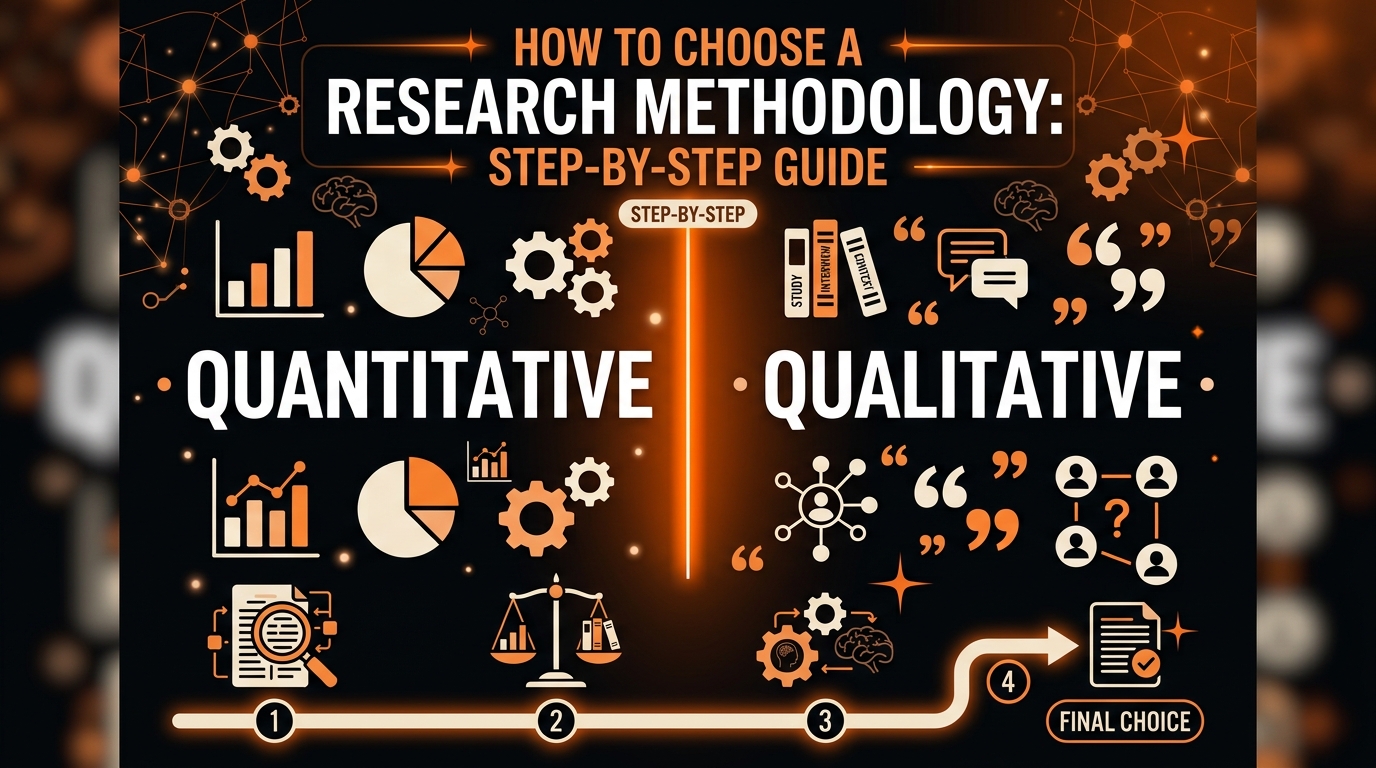
  • How to Choose a Research Methodology: Step-by-Step Guide

    How to Choose a Research Methodology: Step-by-Step Guide

    Research Publication Portal

    Ready to Publish Your Findings? Submit Your Manuscript Today

    Move from methodology design and data collection to formal peer-reviewed academic publication through our expert submission workflow.

    How to Choose a Research Methodology: A Practical Framework

    Selecting a research methodology is often the most anxiety-inducing step for undergraduate, master’s, and doctoral candidates. Choosing the wrong approach can invalidate months of data collection, stall your thesis defense, or result in outright rejection from peer-reviewed journals. Yet, methodology selection does not have to be a guessing game.

    Building upon our foundational series—including how to use Google Scholar for academic research, how to find research papers efficiently, and our comparative analysis on quantitative vs qualitative research—this guide provides a structured, step-by-step framework to align your research question with the optimal methodological design.

    The 4-Step Methodology Selection Framework

    To determine whether your study requires a quantitative, qualitative, or mixed-methods design, systematically evaluate four core parameters of your research problem.

    Decision Step Evaluating Criteria Quantitative Indicator Qualitative Indicator
    Step 1: Research Objective What is the primary goal of the investigation? To test, verify, or generalize existing theories and statistical models. To explore, understand, or build new conceptual frameworks.
    Step 2: Nature of Variables Can your core concepts be measured numerically? Yes, variables are clear, measurable, and independent/dependent. No, variables are fluid, subjective, and context-dependent.
    Step 3: Literature Maturity How much existing literature supports your topic? Extensive literature exists with established scales and metrics. Limited or emerging literature where human experiences need deep unpacking.
    Step 4: Data Accessibility What kind of data can you feasibly collect? Large-scale surveys, transactional data, or experimental metrics. In-depth interviews, focus groups, or ethnographic observations.

    1. Aligning Research Questions with Methodological Design

    Your research question is the ultimate compass for your methodology. If your question starts with “How much,” “What is the extent of,” or “Does X affect Y,” your study leans inherently quantitative. Conversely, if your question starts with “How do participants experience,” “What is the meaning of,” or “Why do stakeholders perceive,” your study requires a qualitative framework.

    Quantitative Question Archetypes

    • Relationship: What is the impact of social media advertising spend on consumer purchasing frequency in retail SMEs?
    • Comparison: Is there a statistically significant difference in academic performance between online and hybrid learning cohorts?

    Qualitative Question Archetypes

    • Phenomenological: How do small business owners in emerging economies experience mobile money transaction friction?
    • Exploratory: What underlying cultural factors influence brand loyalty among Gen Z consumers in urban centers?

    2. Avoiding Common Methodological Pitfalls

    Researchers frequently make critical errors during the design phase that jeopardize their entire project. Recognizing these pitfalls early ensures structural integrity:

    • Methodological Mismatch: Choosing a trendy or familiar methodology rather than one dictated by the research question.
    • Unrealistic Data Access: Proposing a massive national quantitative survey without having institutional access or funding.
    • Ignoring Epistemological Assumptions: Mixing incompatible philosophical stances regarding how knowledge is constructed without a clear mixed-methods justification.

    Expert Methodological Advice

    Always draft your research questions before deciding on your data collection tools. Let the problem dictate the method, never let the method dictate the problem.

    Frequently Asked Questions

    How do I justify my methodology in a thesis proposal?

    Your justification must connect your core research questions directly to the strengths of the chosen design, citing methodological literature and precedent studies in your field.

    What if my research question requires both numbers and narratives?

    Adopt a convergent or explanatory sequential mixed-methods design, where quantitative and qualitative phases complement and validate each other.

    Can I change my methodology after starting data collection?

    Changing methodologies mid-stream is extremely disruptive and usually avoided. Rigorous upfront pilot testing prevents the need for drastic pivots later.

    Author Account

    Manage Your Submissions in Your Publisher Account

    Track review statuses, communicate directly with editorial boards, and manage your published research portfolio in one secure dashboard.