Category: Research & Methodology

Guidance on quantitative, qualitative, and mixed-methods research, data analysis, and thesis/dissertation writing.

  • How to Publish Open Access & Avoid Predatory Publishers

    Research Publication Portal

    Ready to Share Your Complete Portfolio? Submit Your Manuscript Today

    Move from rigorous data collection, writing, and peer review to permanent global academic indexing through our professional publishing workflow.

    How to Publish Open Access: Choosing Journals and Avoiding Predatory Publishers

    The academic publishing landscape has undergone a monumental shift toward Open Access (OA), democratizing knowledge by making research articles immediately free to read and cite worldwide. However, the rapid expansion of digital publishing has also introduced predatory journals seeking to exploit eager authors through exorbitant fees and fake peer-review standards.

    Building upon our comprehensive academic series—including how to use Google Scholar for academic research, how to write a research proposal, how to write an empirical research paper, and how to navigate peer review and respond to reviewer comments—this guide provides an essential framework for selecting legitimate open-access journals and safeguarding your scholarly reputation.

    1. Understanding Open Access Models

    Open access publishing generally operates through different color-coded pathways, each dictating copyright ownership, archiving rights, and publication costs.

    Gold Open Access

    Articles are immediately free on the publisher’s site, typically funded by an Article Processing Charge (APC) paid by the author or institution.

    Green Open Access

    Authors self-archive a preprint or post-print version of their peer-reviewed paper in an institutional or open repository for free public access.

    Hybrid Open Access

    Traditional subscription-based journals allow individual articles to become open access if the authors pay an optional supplemental APC fee.

    Diamond / Platinum OA

    Journals that are completely free for readers and charge zero APCs to authors, typically subsidized by universities, societies, or governments.

    2. Comparative Matrix: Legitimate Journals vs. Predatory Publishers

    Knowing how to spot warning signs protects your research investment from fraudulent operators who promise instant publication with zero genuine peer review.

    Evaluation Metric Legitimate Open Access Journals Predatory / Fake Publishers Verification Resource
    Peer Review Process Rigorous, transparent double-blind review taking weeks or months. Guaranteed acceptance within 24 to 72 hours with no substantive edits. Directory of Open Access Journals (DOAJ)
    Editorial Board Composed of internationally recognized, verifiable professors. Fake profiles, stolen names, or completely absent bios. ORCID records & university faculty directories
    Fee Transparency Clear, upfront publication fee schedules displayed before submission. Hidden fees revealed only *after* the manuscript is accepted. “Think. Check. Submit.” campaign guidelines

    3. The “Think. Check. Submit.” Evaluation Framework

    Before submitting your manuscript to any unfamiliar journal, run through this globally recognized checklist to verify credibility and protect your academic standing.

    1. Think

    Evaluate your research goals. Are you submitting to a trusted journal that matches your field, readership, and career objectives?

    2. Check

    Verify journal credentials. Do you recognize the publisher? Is the journal indexed in DOAJ, Scopus, or Web of Science?

    3. Submit

    Proceed only if you are confident in their peer-review integrity, archiving policies, and clear APC structures.

    Open Access Pro-Tip

    Always check if your university or research institution has an “Institutional Open Access Agreement” or transformative Read & Publish deal that covers or discounts your APC fees automatically.

    Frequently Asked Questions

    What are Article Processing Charges (APCs), and can they be waived?

    APCs are fees charged by open-access publishers to cover editorial processing, formatting, and hosting costs. Many reputable publishers offer automatic fee waivers or profound discounts for researchers based in low- and middle-income countries.

    Does open access publishing improve citation impact?

    Yes. Numerous bibliometric studies demonstrate that open-access articles enjoy significantly higher visibility, broader global readership, and an increased citation advantage compared to paywalled literature.

    How can I verify if a journal is indexed in legitimate databases?

    Search directly within official indexing databases like the Directory of Open Access Journals (DOAJ), Scopus Source List, or Clarivate’s Master Journal List rather than trusting claims made on a journal’s homepage.

    Author Account

    Track Your Published Portfolio in Your Publisher Account

    Monitor publication analytics, citation metrics, and manage your open-access manuscript portfolio from your centralized dashboard.
  • How to Navigate Peer Review and Respond to Reviewers

    Research Publication Portal

    Ready to Submit Your Manuscript? Publish Your Research Today

    Navigate peer review successfully and share your academic findings with the global scholarly community through our streamlined submission portal.

    How to Navigate Peer Review and Respond to Reviewer Comments

    Receiving an editorial decision letter after months of painstaking research is a pivotal moment in any scholar’s journey. Whether your manuscript returns with a “Major Revision,” “Minor Revision,” or the dreaded rejection, navigating the peer-review process with professional resilience is the definitive skill that separates novice writers from seasoned, published authors.

    Building upon our comprehensive academic series—including how to use Google Scholar for academic research, how to structure a literature review, how to write a research proposal, how to write an empirical research paper, and our companion guides on quantitative and qualitative data analysis—this article provides a masterclass on decoding reviewer critique and crafting winning response letters.

    1. Deciphering Editorial Decision Outcomes

    Before drafting any changes to your manuscript, it is crucial to accurately interpret the journal editor’s decision and understand what the feedback actually demands.

    Acceptance / Minor Revisions

    Minor tweaks needed for typos, reference formatting, or slight clarifications. Acceptance is virtually guaranteed upon compliance.

    Major Revisions Required

    Substantial restructuring, additional literature citations, or secondary data robustness checks required before re-evaluation.

    Revise & Resubmit (New Round)

    Treats the manuscript almost as a new submission. Requires deep foundational adjustments and goes back out to peer reviewers.

    Outright Rejection

    The paper does not fit scope or lacks methodological rigor. Salvage constructive feedback, reformat, and submit to an alternative journal.

    2. Comparative Matrix: Crafting the Response-to-Reviewers Document

    Your “Response to Reviewers” (or Rebuttal Letter) is the most critical document during revisions. It must be polite, exhaustive, and meticulously organized.

    Letter Component Strategic Objective Best Practice Execution Common Pitfall
    Opening Statement Establish a collaborative and appreciative tone. Thank the editor and reviewers for their time and insightful feedback. Sounding defensive, arrogant, or dismissive in the opening paragraph.
    Reviewer Point-by-Point Demonstrate systematic compliance with every single critique. Quote reviewer comment in full, followed by your explicit action response. Ignoring minor comments or skipping points you disagree with.
    Tracked Changes Reference Make verification effortless for the editor and reviewers. Provide exact page and line numbers where edits were implemented. Saying “we revised the text” without showing precisely where or how.

    3. The 4 Golden Rules for Handling Disagreement

    You do not always have to blindly agree with every reviewer suggestion, but respectful academic pushback requires supreme diplomacy and robust justification.

    1. Separate Ego from the Paper

    Never take criticism personally. Reviewers want to strengthen your work to protect the journal’s reputation and advance the field.

    2. Provide Empirical Evidence

    If you decline a suggestion to add more data or change a model, back up your refusal with solid methodological citations or logical constraints.

    3. Clarify Misunderstandings

    If a reviewer misinterprets your text, assume the original phrasing was ambiguous and rewrite that section for crystal-clear comprehension.

    Peer Review Pro-Tip

    Always maintain a master folder containing your original submission, the editor’s decision letter, individual reviewer files, your drafted rebuttal letter, and the clean/tracked revision files.

    Frequently Asked Questions

    What should I do if two reviewers give contradictory feedback?

    Politely point out the contradiction in your response letter to the editor. Adopt the recommendation of the reviewer whose perspective better aligns with the core scope of your study, and briefly explain your rationale.

    Is it acceptable to ask for a deadline extension for major revisions?

    Yes. If you need extra time to run additional laboratory experiments, field surveys, or complex econometric models, email the editorial office well before the deadline to request a reasonable extension (typically 2 to 4 weeks).

    How should I handle a rejection after revisions?

    Do not be discouraged. Peer review is iterative. Incorporate the valuable feedback gained during the review cycle, refine your manuscript, and target a more suitable specialized journal.

    Author Account

    Track Your Review Status in Your Publisher Account

    Monitor editorial stages, upload revised manuscript packages, and communicate securely with your managing editors.

  • How to Write an Empirical Research Paper: Structure & Guide

    Research Publication Portal

    Ready to Publish Your Final Manuscript? Submit Your Work Today

    Transition from data analysis and drafting to formal peer-reviewed academic publication through our expert submission workflow.

    How to Write and Structure an Empirical Research Paper

    Translating months of fieldwork, data collection, and statistical or thematic analysis into a coherent academic manuscript is the ultimate milestone of any research project. An empirical research paper does not merely report results; it constructs a compelling, evidence-based narrative that contributes original knowledge to global scholarship.

    Building upon our comprehensive academic series—including how to use Google Scholar for academic research, how to structure a literature review, how to write a research proposal, how to collect and analyze quantitative data, and how to collect and analyze qualitative data—this guide provides a step-by-step blueprint for mastering the standard IMRAD format.

    1. The Anatomy of the IMRAD Format

    Virtually all peer-reviewed scientific and social science journals require manuscripts to follow the IMRAD structure (Introduction, Methods, Results, and Discussion), flanked by an abstract and conclusion.

    1. Introduction

    Establishes the background, articulates the problem statement, reviews prior literature gaps, and states specific research objectives.

    2. Methodology

    Details study design, population sampling, data collection instruments, and analytical software so others can replicate your work.

    3. Results

    Presents objective statistical findings or qualitative thematic codes using well-formatted data tables and visual charts.

    4. Discussion

    Interprets findings against existing literature, notes unexpected anomalies, acknowledges study limitations, and suggests future directions.

    2. Comparative Matrix: Writing Best Practices Across Sections

    Each section of an empirical paper serves a distinct rhetorical function. Mixing tones or confusing results with discussion is the #1 reason manuscripts face desk rejection.

    Paper Section Primary Objective Tense & Voice Common Pitfall to Avoid
    Introduction Hook the reader and justify the study. Present tense for established facts; past tense for past studies. Writing an exhaustive book review instead of a focused gap analysis.
    Methodology Explain exactly how the study was executed. Past tense (describing what was done). Omitting critical parameters needed for replication.
    Results Report data objectively without interpretation. Past tense for reported experimental outcomes. Injecting subjective opinions or comparing with outside literature too early.

    3. Drafting Strategy: Order of Composition

    Experienced academic authors rarely write a manuscript sequentially from page one to the end. Utilizing a modular writing order accelerates momentum and ensures logical alignment.

    Phase 1: Methods & Results

    Start here while your statistical analyses and coding outputs are fresh. Write your data tables and methodological steps first.

    Phase 2: Discussion & Intro

    Draft the discussion interpreting your empirical data, then write the introduction to frame the study leading directly into those findings.

    Phase 3: Abstract & Title

    Write the abstract and optimize your title last, once the entire narrative arc of the paper is fully polished and verified.

    Manuscript Polish Pro-Tip

    Before submitting to a journal, check your target journal’s specific author guidelines regarding word limits, reference styles (APA, MLA, Harvard), and formatting requirements to avoid immediate administrative rejection.

    Frequently Asked Questions

    What is the ideal word count for an empirical research paper?

    Standard empirical articles published in peer-reviewed journals typically range between 6,000 and 8,000 words, including references, tables, and appendices.

    How do I handle negative or unexpected results in the Discussion?

    Never hide unexpected results. Transparently address them, explore potential confounding variables, and discuss how they open exciting avenues for future scholarly inquiry.

    What makes a strong research title?

    A strong title is concise, informative, and rich in searchable keywords that clearly reflect your core variables and population scope without using sensationalist language.

    Author Account

    Manage Your Submissions in Your Publisher Account

    Track review statuses, communicate directly with editorial boards, and manage your published research portfolio in one secure dashboard.

  • How to Collect and Analyze Quantitative Data: Complete Guide

    Research Publication Portal

    Ready to Publish Your Findings? Submit Your Manuscript Today

    Transition from approved research proposals and data collection to formal peer-reviewed publication through our academic portal.

    How to Collect and Analyze Quantitative Data: A Complete Guide

    Data collection and statistical analysis form the empirical backbone of quantitative research. Whether testing econometric models, evaluating survey responses, or measuring experimental outcomes, your ability to collect clean data and apply appropriate statistical tests dictates the validity and publishability of your final manuscript.

    Building upon our comprehensive academic series—including how to use Google Scholar for academic research, quantitative vs qualitative research, how to choose a research methodology, and how to write a research proposal—this guide provides a step-by-step framework for executing quantitative fieldwork and running statistical tests.

    1. The Quantitative Research Workflow

    Executing a robust quantitative study requires moving through four disciplined stages, ensuring data integrity from survey design down to econometric interpretation.

    1. Instrument Design

    Developing structured questionnaires, Likert scales, or automated data capture tools aligned with operationalized variables.

    2. Sampling & Collection

    Deploying random or stratified sampling techniques to secure representative sample sizes with minimal sampling error.

    3. Data Cleaning & Coding

    Screening raw datasets for missing values, outliers, and coding categorical responses into numerical values for software processing.

    4. Statistical Testing

    Executing descriptive and inferential tests (e.g., ANOVA, regression) using software like SPSS or Microsoft Excel.

    2. Comparative Matrix: Selecting the Right Statistical Test

    Choosing the incorrect statistical test leads to invalid p-values and flawed empirical conclusions. Match your test selection to your data types and research hypotheses.

    Research Objective Parametric Test Non-Parametric Alternative Primary Application
    Comparing Two Groups Independent Samples t-test Mann-Whitney U Test Testing mean differences between two distinct cohorts.
    Comparing Three+ Groups One-Way ANOVA Kruskal-Wallis Test Evaluating variance across multiple experimental treatments.
    Predicting Relationships Multiple Linear Regression Ordinal / Logistic Regression Determining the impact of independent variables on a dependent metric.

    3. Essential Data Cleaning Protocols

    Raw datasets are rarely ready for immediate analysis. Neglecting pre-estimation diagnostics can severely bias your regression coefficients and test statistics.

    1. Missing Data Treatment

    Identify missing survey responses and decide whether to apply listwise deletion, mean imputation, or multiple imputation.

    2. Outlier Detection

    Use boxplots, z-scores, and Cook’s distance to flag extreme data points that distort parametric means and variances.

    3. Normality Testing

    Run Kolmogorov-Smirnov or Shapiro-Wilk tests to verify whether continuous variables meet parametric normality assumptions.

    Data Analysis Pro-Tip

    Always conduct a pilot test with 10% of your target sample size before launching full-scale data collection. This uncovers ambiguous survey questions and validates your coding structure early.

    Frequently Asked Questions

    What software is best for analyzing quantitative research data?

    SPSS and Microsoft Excel are industry standards for academic research and descriptive statistics, while R and Python are favored for advanced econometric modeling and machine learning.

    How do I determine my minimum required sample size?

    Sample size depends on your statistical power, effect size, and significance level (alpha). Use G*Power software or Cochran’s sample size formula to calculate exact requirements.

    What is the difference between parametric and non-parametric tests?

    Parametric tests assume data is normally distributed and measured on interval/ratio scales, whereas non-parametric tests make no distributional assumptions and handle ordinal or ranked data.

    Author Account

    Manage Your Submissions in Your Publisher Account

    Track review statuses, communicate directly with editorial boards, and manage your published research portfolio in one secure dashboard.

  • How to Write a Research Proposal: Structure & Template

    Research Publication Portal

    Ready to Publish Your Research? Submit Your Manuscript Today

    Move from literature synthesis and proposal drafting to formal peer-reviewed academic publication through our expert submission workflow.

    How to Write a Research Proposal: Structure, Components, & Template

    A research proposal is the definitive blueprint that convinces academic committees, grant panels, and institutional review boards that your proposed study is scientifically sound, methodologically rigorous, and worth funding or supervising. Yet, many early-career researchers struggle because they treat a proposal like an essay rather than a precise operational plan.

    Building upon our comprehensive series—including how to use Google Scholar for academic research, how to find research topics, and how to structure a literature review—this guide provides an actionable framework and component blueprint for drafting a winning academic proposal.

    1. The Anatomy of a Standard Research Proposal

    While specific institutional formatting guidelines vary across university departments and funding agencies, almost all high-scoring research proposals follow a standardized structural sequence.

    1. Title & Abstract

    A concise, keyword-optimized title and a 250-word summary outlining your problem, methodology, and expected contribution.

    2. Introduction & Problem Statement

    Establishes the real-world context, defines the knowledge gap, and justifies why investigating this issue matters right now.

    3. Literature Review Synthesis

    Summarizes existing theoretical frameworks and demonstrates precisely where previous studies fall short.

    4. Methodology & Work Plan

    Details your research design, data collection instruments, sampling strategy, analytical techniques, and timeline.

    2. Comparative Matrix: Proposal Requirements Across Academic Tiers

    Expectations for depth and empirical rigor shift depending on whether you are writing an undergraduate project proposal, a master’s thesis plan, or a doctoral grant application.

    Proposal Parameter Undergraduate Capstone Master’s Thesis Proposal Doctoral / Grant Proposal
    Standard Word Count 1,500 – 3,000 words 3,000 – 6,000 words 10,000+ words
    Literature Scope 15 – 30 foundational sources 40 – 75 peer-reviewed sources 100+ comprehensive global sources
    Novelty Requirement Application of existing concepts to a localized case. Contextual adaptation or minor theoretical extension. Substantial theoretical or empirical contribution to global literature.

    3. Crafting the Problem Statement: The Funnel Approach

    The problem statement is the beating heart of your proposal. If reviewers do not believe a significant problem exists, the rest of your methodology will be dismissed.

    1. The Ideal State

    Describe how things ought to function in an optimal environment or industry standard.

    2. The Reality Gap

    Present empirical evidence or operational data showing where current practice falls short of the ideal.

    3. The Proposed Solution

    State precisely how your study will investigate and bridge this documented gap.

    Proposal Defense Pro-Tip

    Anticipate committee objections regarding feasibility. Ensure your proposed sample size, data access permissions, and analytical software tools are fully secured before submitting your proposal for defense.

    Frequently Asked Questions

    What is the difference between a research proposal and a research paper?

    A proposal is written in future tense as a plan or bid for a future study, whereas a research paper is written in past tense, detailing completed data collection, analysis, and results.

    How specific should research questions be in a proposal?

    Research questions must be laser-focused, measurable, and directly tied to your stated objectives and hypotheses. Avoid overly broad or multi-part compound questions.

    Can I modify my methodology after proposal approval?

    Minor adjustments are sometimes permitted during execution, but major structural changes usually require formal review and approval from your academic advisor or ethics committee.

    Author Account

    Manage Your Submissions in Your Publisher Account

    Track review statuses, communicate directly with editorial boards, and manage your published research portfolio in one secure dashboard.

  • How to Structure a Literature Review: Step-by-Step Blueprint

    Research Publication Portal

    Ready to Publish Your Research? Submit Your Manuscript Today

    Move from literature review and methodology design to formal peer-reviewed academic publication through our expert submission workflow.

    How to Structure a Literature Review: A Step-by-Step Academic Blueprint

    A well-structured literature review is much more than a chronological summary of previously published papers; it is the critical intellectual scaffolding that justifies your entire research study. Whether writing a master’s thesis, a doctoral dissertation, or a peer-reviewed journal article, your literature review must synthesize existing knowledge, expose conceptual gaps, and position your unique research question as the logical next step.

    Building upon our foundational series—including how to use Google Scholar for academic research, our analysis on quantitative vs qualitative research, and how to choose a research methodology—this guide breaks down the architecture of a high-impact literature review using modular card sections and comparison matrices.

    1. The Four Core Structural Models

    How you organize your reviewed sources determines the flow and persuasiveness of your argument. Selecting the correct structural model prevents your review from reading like an unorganized annotated bibliography.

    The Thematic Model

    Organizes sources around recurring topics, debates, or sub-issues rather than authors or publication dates. Best for multi-faceted conceptual frameworks.

    The Methodological Model

    Groups literature based on the methods researchers used (e.g., qualitative case studies vs. large-scale econometric models). Highlights strengths and flaws across data approaches.

    The Chronological Model

    Traces the historical evolution of a concept over time. Ideal for showing how a theory emerged, matured, or was debunked across decades.

    The Theoretical Model

    Focuses on competing theoretical frameworks or models that attempt to explain a phenomenon. Evaluates which paradigm holds strongest empirical backing.

    2. Comparative Matrix: Chronological vs. Thematic Approaches

    Choosing between structural frameworks requires weighing your research objectives against the maturity of your field.

    Evaluation Parameter Chronological Structure Thematic Structure
    Primary Focus Timeline of discovery and historical development. Key concepts, debates, and thematic clusters.
    Synthesis Depth Low to moderate (risks becoming a list of summaries). High (synthesizes multiple authors under single thematic headings).
    Best Suited For Tracing how a specific law, policy, or paradigm shifted over eras. Modern interdisciplinary research with dense, overlapping literature.

    3. The 3-Part Macro Structure of a Literature Review

    Every exceptional literature review follows a macro-structural funnel shape, guiding the reader from broad contextual landscapes down to your precise research niche.

    1. The Introduction (The Broad Lens)

    Define the overarching topic, explain its significance, state your operational definitions, and outline the organizing principle of your review.

    2. The Body (Critical Synthesis)

    Group literature into thematic or methodological subsections. Contrast findings, highlight agreements, dissect contradictions, and expose research gaps.

    3. The Conclusion (The Gap & Bridge)

    Summarize major takeaways, explicitly state the gap your study addresses, and show how your research questions bridge that exact void.

    Pro-Tip for Literature Synthesis

    Never write sentences like “Smith (2023) said X, and Jones (2024) said Y.” Instead, synthesize: “While Smith (2023) argues X, subsequent findings by Jones (2024) demonstrate that Y is moderated by institutional context.”

    Frequently Asked Questions

    How long should a literature review be?

    For a thesis or dissertation, a literature review typically constitutes 15% to 25% of the total word count. For journal articles, it forms a concise 2,000 to 4,000-word introduction and background section.

    How do I know when I have enough sources?

    You reach saturation when your search terms consistently yield papers you have already reviewed or cited, indicating you have mapped the core discourse of your field.

    Should I include studies that contradict my hypothesis?

    Yes, absolutely. Addressing and critically analyzing conflicting evidence strengthens your academic credibility and demonstrates rigorous scholarly balance.

    Author Account

    Manage Your Submissions in Your Publisher Account

    Track review statuses, communicate directly with editorial boards, and manage your published research portfolio in one secure dashboard.

  • How to Choose a Research Methodology: Step-by-Step Guide

    How to Choose a Research Methodology: Step-by-Step Guide

    Research Publication Portal

    Ready to Publish Your Findings? Submit Your Manuscript Today

    Move from methodology design and data collection to formal peer-reviewed academic publication through our expert submission workflow.

    How to Choose a Research Methodology: A Practical Framework

    Selecting a research methodology is often the most anxiety-inducing step for undergraduate, master’s, and doctoral candidates. Choosing the wrong approach can invalidate months of data collection, stall your thesis defense, or result in outright rejection from peer-reviewed journals. Yet, methodology selection does not have to be a guessing game.

    Building upon our foundational series—including how to use Google Scholar for academic research, how to find research papers efficiently, and our comparative analysis on quantitative vs qualitative research—this guide provides a structured, step-by-step framework to align your research question with the optimal methodological design.

    The 4-Step Methodology Selection Framework

    To determine whether your study requires a quantitative, qualitative, or mixed-methods design, systematically evaluate four core parameters of your research problem.

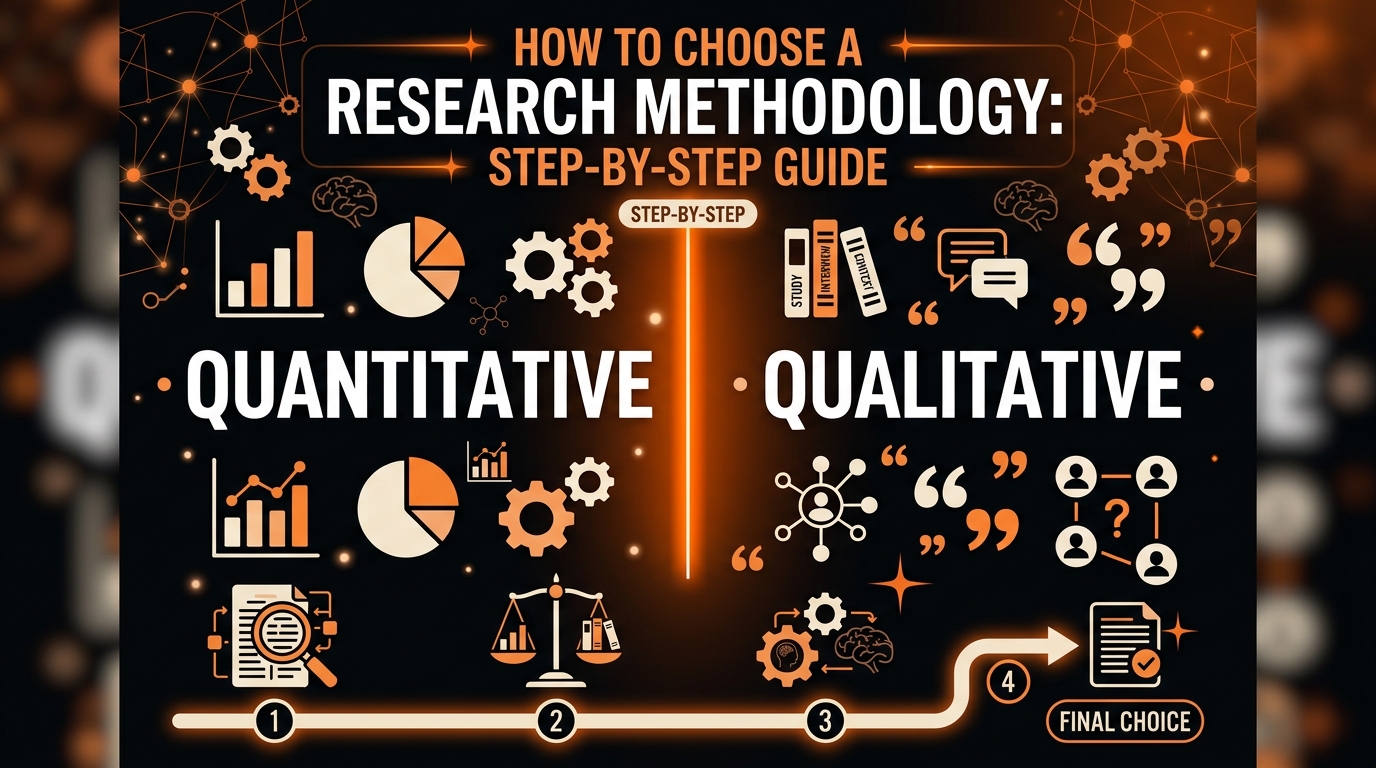
    Decision Step Evaluating Criteria Quantitative Indicator Qualitative Indicator
    Step 1: Research Objective What is the primary goal of the investigation? To test, verify, or generalize existing theories and statistical models. To explore, understand, or build new conceptual frameworks.
    Step 2: Nature of Variables Can your core concepts be measured numerically? Yes, variables are clear, measurable, and independent/dependent. No, variables are fluid, subjective, and context-dependent.
    Step 3: Literature Maturity How much existing literature supports your topic? Extensive literature exists with established scales and metrics. Limited or emerging literature where human experiences need deep unpacking.
    Step 4: Data Accessibility What kind of data can you feasibly collect? Large-scale surveys, transactional data, or experimental metrics. In-depth interviews, focus groups, or ethnographic observations.

    1. Aligning Research Questions with Methodological Design

    Your research question is the ultimate compass for your methodology. If your question starts with “How much,” “What is the extent of,” or “Does X affect Y,” your study leans inherently quantitative. Conversely, if your question starts with “How do participants experience,” “What is the meaning of,” or “Why do stakeholders perceive,” your study requires a qualitative framework.

    Quantitative Question Archetypes

    • Relationship: What is the impact of social media advertising spend on consumer purchasing frequency in retail SMEs?
    • Comparison: Is there a statistically significant difference in academic performance between online and hybrid learning cohorts?

    Qualitative Question Archetypes

    • Phenomenological: How do small business owners in emerging economies experience mobile money transaction friction?
    • Exploratory: What underlying cultural factors influence brand loyalty among Gen Z consumers in urban centers?

    2. Avoiding Common Methodological Pitfalls

    Researchers frequently make critical errors during the design phase that jeopardize their entire project. Recognizing these pitfalls early ensures structural integrity:

    • Methodological Mismatch: Choosing a trendy or familiar methodology rather than one dictated by the research question.
    • Unrealistic Data Access: Proposing a massive national quantitative survey without having institutional access or funding.
    • Ignoring Epistemological Assumptions: Mixing incompatible philosophical stances regarding how knowledge is constructed without a clear mixed-methods justification.

    Expert Methodological Advice

    Always draft your research questions before deciding on your data collection tools. Let the problem dictate the method, never let the method dictate the problem.

    Frequently Asked Questions

    How do I justify my methodology in a thesis proposal?

    Your justification must connect your core research questions directly to the strengths of the chosen design, citing methodological literature and precedent studies in your field.

    What if my research question requires both numbers and narratives?

    Adopt a convergent or explanatory sequential mixed-methods design, where quantitative and qualitative phases complement and validate each other.

    Can I change my methodology after starting data collection?

    Changing methodologies mid-stream is extremely disruptive and usually avoided. Rigorous upfront pilot testing prevents the need for drastic pivots later.

    Author Account

    Manage Your Submissions in Your Publisher Account

    Track review statuses, communicate directly with editorial boards, and manage your published research portfolio in one secure dashboard.

  • Quantitative vs Qualitative Research: Key Differences & Guide

    Quantitative vs Qualitative Research: Key Differences & Guide

    Academic Publishing

    Ready to Share Your Research? Submit Your Manuscript Today

    Move from theoretical framework design to formal peer-reviewed publication through our academic portal.

    Quantitative vs Qualitative Research: Choosing the Right Methodology

    Selecting the appropriate research methodology is the foundational pivot of any rigorous academic study. Whether investigating market trends, educational outcomes, or consumer behavior, your choice between quantitative and qualitative approaches determines your data collection instruments, analytical procedures, and final interpretive validity.

    Building upon our foundational series—including how to use Google Scholar for academic research, how to find research papers efficiently, and how to find research topics using Google Scholar—this guide breaks down the core structural differences between quantitative and qualitative paradigms.

    Core Methodological Comparison

    To understand which methodology aligns with your research question, examine the structural contrasts across philosophical foundations, data types, and analytical goals.

    Research Dimension Quantitative Research Qualitative Research
    Primary Purpose To test existing theories, establish cause-and-effect relationships, and generalize findings. To explore ideas, understand underlying motivations, and gain deep contextual insights.
    Data Form Numerical data, statistical metrics, closed-ended survey responses, and structured measurements. Textual transcripts, open-ended interviews, observational notes, and digital media artifacts.
    Data Analysis Statistical and econometric testing (e.g., SPSS, regression analysis, ANOVA). Thematic coding, discourse analysis, content categorization, and narrative synthesis.
    Sample Strategy Large, randomly selected samples designed for statistical representation. Purposely selected small samples focused on depth of information over breadth.

    1. Quantitative Research: Mechanics and Applications

    Quantitative research focuses on objective measurement and the statistical analysis of numerical data gathered through polls, questionnaires, surveys, or computational manipulation of pre-existing statistical datasets.

    Key Quantitative Strengths

    • Generalizability: Findings from large, representative samples can be generalized to broader populations.
    • Replicability: Standardized procedures and statistical codes allow other researchers to replicate studies precisely.
    • Hypothesis Testing: Ideal for proving or disproving explicit directional relationships between variables.

    Primary Limitations

    • Inflexibility: Research design cannot be altered once data collection instruments are deployed.
    • Surface Depth: Focuses heavily on numbers and frequencies, potentially missing underlying human motivations.

    2. Qualitative Research: Mechanics and Applications

    Qualitative research focuses on collecting and analyzing non-numerical data to understand concepts, opinions, or subjective human experiences. It answers questions about how and why phenomena occur within specific social contexts.

    Key Qualitative Strengths

    • Contextual Richness: Captures complex human nuances, cultural dynamics, and subjective viewpoints.
    • Adaptability: Interview guides and observational focus areas can evolve as fieldwork uncovers unexpected insights.
    • Theory Generation: Excellent for exploratory studies where little prior literature exists.

    Primary Limitations

    • Subjectivity: Interpretation relies heavily on researcher lens, introducing potential bias.
    • Difficult to Generalize: Findings are context-specific and cannot be broadly scaled to large populations.

    3. The Mixed Methods Approach

    Modern academic research often transcends the rigid binary between numbers and narratives. Mixed-methods research combines quantitative and qualitative data collection within a single study to achieve triangulation—validating statistical findings through deep qualitative context, or framing qualitative observations with robust numerical metrics.

    Methodological Selection Checklist

    Ask yourself three key questions: (1) Does my research question require measuring variables or exploring experiences? (2) Is existing literature mature enough for hypothesis testing, or do I need exploratory grounding? (3) What data collection access do I possess?

    Frequently Asked Questions

    Which research methodology is better for a master’s thesis?

    Neither methodology is inherently superior. The right choice depends entirely on your specific research question, theoretical framework, and data access constraints.

    Can I combine quantitative and qualitative methods in one paper?

    Yes. This is known as a mixed-methods design and is increasingly favored in multidisciplinary research for providing comprehensive validation.

    How do I determine my sample size for quantitative vs. qualitative studies?

    Quantitative studies rely on statistical power calculations and sampling error formulas, whereas qualitative studies rely on the principle of “data saturation”—continuing interviews until no new thematic insights emerge.

    Author Account

    Manage Your Submissions in Your Publisher Account

    Track review statuses, communicate with editorial boards, and manage your published research portfolio.

  • Semantic Scholar vs Google Scholar: Which is Better for Research?

    Semantic Scholar vs Google Scholar: Which is Better for Research?

    Platform Submission

    Ready to Share Your Findings? Submit Your Manuscript Today

    Move from literature discovery and synthesis to formal academic publication through our peer-reviewed submission portal.

    Semantic Scholar vs Google Scholar: Which is Better for Academic Research?

    Choosing the right academic search engine dictates how efficiently you map your literature review, track citation networks, and uncover foundational theories. While Google Scholar has long served as the default entry point for student and faculty research, alternative academic discovery engines like Semantic Scholar have introduced advanced artificial intelligence features that fundamentally change how literature is explored.

    Building upon our foundational guides on how to use Google Scholar for academic research and how to find research papers efficiently, this comparative analysis evaluates both platforms across indexing depth, citation tracking, AI-driven summaries, and practical utility for rigorous research projects.

    Core Architectural Differences: Indexing Scope and Algorithms

    Understanding how each platform crawls and indexes scholarly literature explains why their search results often diverge significantly for the exact same query phrase.

    Feature / Metric Google Scholar Semantic Scholar
    Primary Indexing Focus Broad academic web crawling (journals, preprints, books, patents, theses). Curated scholarly corpus with strong computer science, biomedicine, and multidisciplinary focus.
    AI & NLP Integration Basic keyword and citation matching with limited semantic parsing. Advanced AI citation classification (influential citations vs. background mentions).
    PDF & Open Access Extraction Highlights open versions through web mirrors and institutional repositories. Extracts figures, tables, and specific paper summaries automatically.
    Citation Metrics Traditional citation counts and H-index calculator via individual profiles. Tldr summaries, highly influential citation badges, and citation velocity graphs.

    1. Google Scholar: Strengths and Limitations

    Google Scholar remains the behemoth of digital academic discovery primarily due to its sheer volume and comprehensive web coverage.

    Google Scholar Advantages

    • Unmatched Scale: Indexes hundreds of millions of documents across virtually every academic discipline, including regional and niche journals.
    • Grey Literature Inclusion: Captures conference papers, university institutional repositories, technical reports, and thesis dissertations that other platforms miss.
    • Citation Alerts: Provides reliable email alerts when new papers cite your tracked publications.

    Google Scholar Limitations

    • Algorithmic Opacity: Exact ranking factors and crawling schedules remain proprietary and unpredictable.
    • Metadata Clutter: Search results frequently include duplicate versions, preprints, and low-quality predatory journal articles.
    • Zero AI Synthesis: Does not offer automated summaries or contextualized citation graphs.

    2. Semantic Scholar: Strengths and Limitations

    Developed by the Allen Institute for AI, Semantic Scholar utilizes machine learning to cut through research noise and highlight genuine scholarly impact.

    Semantic Scholar Advantages

    • TLDR Feature: Generates concise one-sentence AI summaries of papers, letting you screen abstracts in seconds.
    • Influential Citations: Differentiates between papers that merely cite a source in their bibliography and those that build directly upon its methodology.
    • Topic and Author Tracking: Clean interface that surfaces related papers and semantic topic clusters without ad clutter.

    Semantic Scholar Limitations

    • Narrower Historical Depth: While expanding rapidly, its coverage of older humanities and regional social science papers can lag behind Google Scholar.
    • Discipline Bias: Historically optimized for computer science, biomedicine, and STEM fields, though multidisciplinary coverage has improved significantly.

    3. Comparative Workflow: When to Use Which Tool

    Rather than treating Google Scholar and Semantic Scholar as mutually exclusive competitors, proficient researchers leverage their distinct strengths across different phases of a literature review.

    1. Exhaustive Discovery Phase: Use Google Scholar when you need to ensure complete bibliographic saturation across niche local journals, government reports, and grey literature.
    2. Literature Filtering & Screening Phase: Transition to Semantic Scholar to leverage TLDR summaries, identify highly influential citations, and quickly discard irrelevant or low-impact papers.
    3. Citation Chaining: Use Semantic Scholar’s visual citation graphs to trace how concepts evolved across landmark publications.

    Research Strategy Best Practice

    Never rely on a single database for a systematic review. Cross-reference search queries between Google Scholar and Semantic Scholar to ensure your literature base is both broad and methodologically rigorous.

    Frequently Asked Questions

    Is Semantic Scholar completely free to use?

    Yes. Semantic Scholar is a free, non-profit research tool provided by the Allen Institute for AI with no subscription paywalls.

    Can I create a researcher profile on Semantic Scholar like Google Scholar?

    Yes. Researchers can claim their author profiles, track their publication impact, and manage citation metrics similarly to Google Scholar profiles.

    Which search engine is better for literature reviews?

    Google Scholar is superior for capturing total volume and grey literature, while Semantic Scholar is better for rapid screening and understanding citation context through machine learning.

    Author Account

    Manage Your Submissions in Your Publisher Account

    Track review statuses, communicate with editorial boards, and manage your published research portfolio.

  • How to Find a Research Topic on Google Scholar Fast

    How to Find a Research Topic on Google Scholar Fast

    Research Ideation

    How to Find Research Topics Using Google Scholar: A Step-by-Step Framework

    Choosing a compelling, viable, and gap-driven research topic is the single most important milestone in your academic journey. Yet, undergraduate students, master’s candidates, and early-career researchers often experience severe writer’s block or select overly broad topics that lead to data collection nightmares.

    Building upon our foundational guides on how to use Google Scholar for academic research and how to find research papers efficiently, this article provides a proven tactical framework to mine the Google Scholar database for high-impact research gaps, emerging trends, and defensible thesis titles.

    Quick Answer: How Do You Discover a Unique Research Topic?

    To uncover a viable research topic using Google Scholar, do not rely on random brainstorming. Instead: (1) Search recent review articles in your broad field, (2) Analyze the “Future Research Directions” or concluding paragraphs of 3 to 5 seminal papers, (3) Apply geographic or contextual variables to established frameworks, and (4) Verify feasibility using citation tracking.

    Key Takeaways

    • Great research topics are born from identified literature gaps, not casual intuition.
    • Review articles and meta-analyses are goldmines for pre-packaged research recommendations.
    • Contextual localization (e.g., applying global models to developing economies) creates immediate academic novelty.
    • Evaluating citation velocity ensures your chosen topic has active scholarly interest.

    1. The Mindset Shift: From Broad Interest to Niche Gap

    A common mistake among researchers is mistaking a broad subject area for a research topic. For example, “Digital Marketing” is a subject area, not a research topic. It is too massive to investigate effectively.

    Google Scholar helps you bridge this gap by allowing you to drill down from macro fields to micro-level research voids. By examining how existing studies conclude their investigations, you can pinpoint exactly what previous authors failed to cover, measure, or test.

    2. Tactical Framework for Mining Research Gaps on Google Scholar

    Follow this 4-step execution workflow to discover and refine your topic using Google Scholar’s indexing features:

    Step 1: Anchor Literature Search

    Search for broad review papers published within the last 3 years using terms like "systematic review" AND your_field.

    Step 2: Conclusion Mining

    Open high-citation review papers and jump straight to their “Limitations” and “Future Research” sections.

    Step 3: Contextual Adaptation

    Take a proven Western or Asian framework and test its validity in a new geographic, demographic, or industrial sector.

    Step 4: Feasibility Validation

    Check citation counts and related articles to ensure sufficient literature exists to support your thesis proposal.

    3. Comparison: Poor Topic Selection vs. Google Scholar-Driven Topics

    To visualize the difference between vague conceptualization and rigorous topic selection, review the comparative matrix below:

    Research Category Poor Topic (Vague & Unfeasible) Optimized Topic (Scholar-Backed & Focused)
    Digital Marketing How social media affects business sales. The Impact of Short-Form Video Content on Consumer Purchase Intention in E-Commerce SMEs.
    Agricultural Economics Problems facing farmers in developing regions. Evaluating Mobile Money Adoption and Post-Harvest Income Efficiency Among Smallholder Farmers.
    Educational Technology Are online classes good for students? Comparative Analysis of Synchronous vs. Asynchronous E-Learning Engagement in Higher Education.
    Financial Technology Cryptocurrency trading trends. Decentralized Finance (DeFi) Liquidity Pools: Risk Assessment and Regulatory Challenges in Emerging Markets.

    4. Using “Review Articles” as Topic Accelerators

    Review articles and meta-analyses are the ultimate shortcuts for topic generation. When authors synthesize 100+ papers in a single publication, they map out the entire landscape of current knowledge—and more importantly, what remains unknown.

    Pro-Tip Search Query: Enter intitle:"systematic literature review" AND "supply chain" 2024..2026 into Google Scholar. Scan the most recent review papers, open them up, and inspect their final discussion paragraphs where authors explicitly state: “Future studies should examine…”

    Evans Research Insight

    The Contextual Novelty Formula: You do not need to invent an entirely new scientific theory to get published. By taking a validated model from one demographic or geographic context and testing it within a fresh regional framework, you create immediate, defensible academic novelty.

    5. Common Pitfalls in Topic Selection

    • Choosing an untestable topic: Selecting grandiose questions that lack accessible data or measurement variables.
    • Ignoring literature saturation: Choosing a topic that has been beaten to death over the last decade without adding a new variable.
    • Failing to align with advisor expertise: Selecting a niche that no faculty member in your department can supervise or evaluate.
    • Skipping preliminary validation: Committing to a title before verifying if 15–20 core reference papers actually exist on Google Scholar.

    Ready to Structure Your Manuscript?

    Once you have secured your research topic on Google Scholar, ensure your proposal and manuscript meet top-tier academic publishing requirements:

    Frequently Asked Questions

    How do I know if my research topic is too broad?

    If typing your proposed topic into Google Scholar returns over 500,000 broad results without clear sub-categories or if you cannot define your exact independent and dependent variables in one sentence, your topic is too broad.

    Can I use Google Scholar citation metrics to judge topic relevance?

    Yes. By sorting search results by “Citation count,” you can identify which sub-topics within your field are attracting the highest academic attention and funding.

    What should I do if my chosen topic has zero recent papers?

    A complete lack of literature usually indicates either a groundbreaking new frontier or an unviable topic with no supporting data. Check adjacent fields or broaden your search keywords slightly.

    How do I write the problem statement after choosing my topic?

    Your problem statement should bridge what is currently known in top-cited literature with the specific knowledge gap your study intends to resolve.