
Ready to Publish Your Findings? Submit Your Manuscript Today
Move from methodology design and data collection to formal peer-reviewed academic publication through our expert submission workflow.
How to Choose a Research Methodology: A Practical Framework
Selecting a research methodology is often the most anxiety-inducing step for undergraduate, master’s, and doctoral candidates. Choosing the wrong approach can invalidate months of data collection, stall your thesis defense, or result in outright rejection from peer-reviewed journals. Yet, methodology selection does not have to be a guessing game.
Building upon our foundational series—including how to use Google Scholar for academic research, how to find research papers efficiently, and our comparative analysis on quantitative vs qualitative research—this guide provides a structured, step-by-step framework to align your research question with the optimal methodological design.
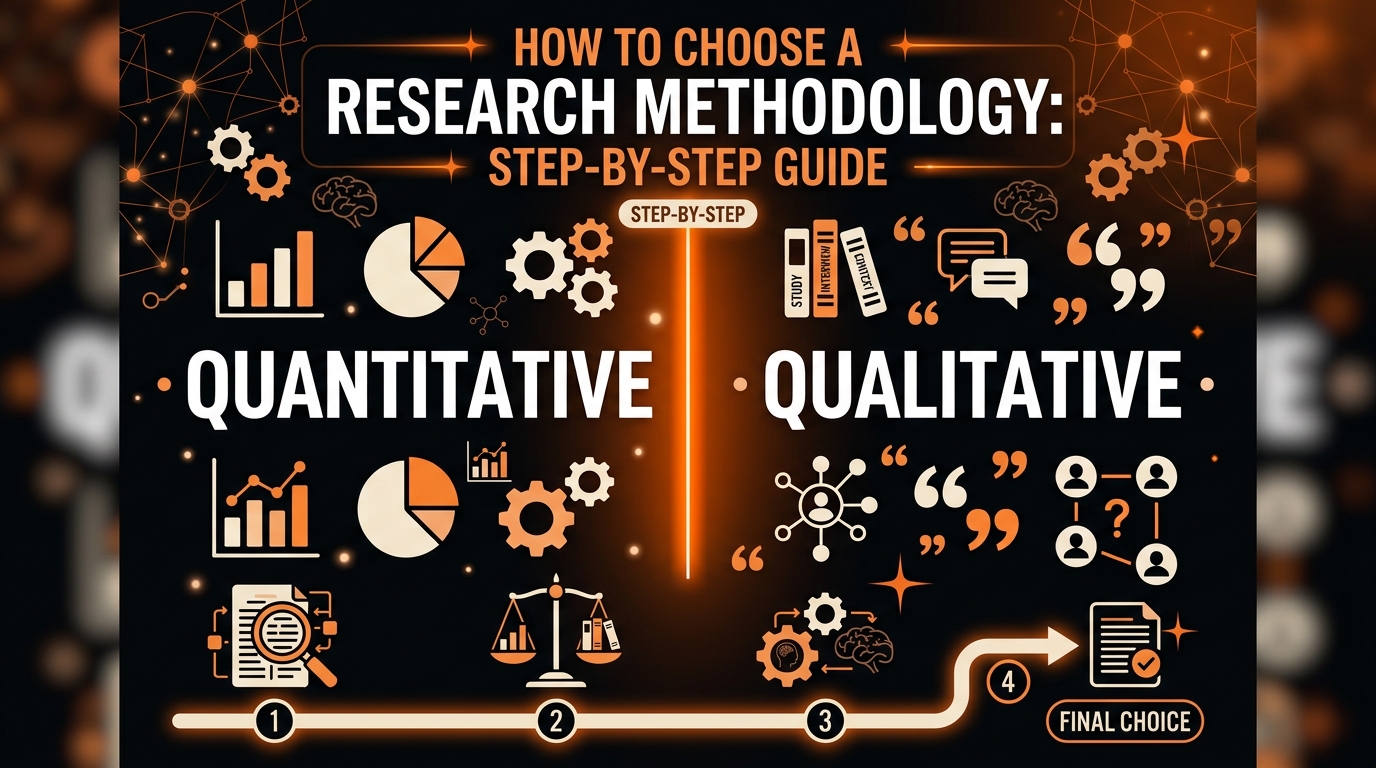
The 4-Step Methodology Selection Framework
To determine whether your study requires a quantitative, qualitative, or mixed-methods design, systematically evaluate four core parameters of your research problem.
| Decision Step | Evaluating Criteria | Quantitative Indicator | Qualitative Indicator |
|---|---|---|---|
| Step 1: Research Objective | What is the primary goal of the investigation? | To test, verify, or generalize existing theories and statistical models. | To explore, understand, or build new conceptual frameworks. |
| Step 2: Nature of Variables | Can your core concepts be measured numerically? | Yes, variables are clear, measurable, and independent/dependent. | No, variables are fluid, subjective, and context-dependent. |
| Step 3: Literature Maturity | How much existing literature supports your topic? | Extensive literature exists with established scales and metrics. | Limited or emerging literature where human experiences need deep unpacking. |
| Step 4: Data Accessibility | What kind of data can you feasibly collect? | Large-scale surveys, transactional data, or experimental metrics. | In-depth interviews, focus groups, or ethnographic observations. |
1. Aligning Research Questions with Methodological Design
Your research question is the ultimate compass for your methodology. If your question starts with “How much,” “What is the extent of,” or “Does X affect Y,” your study leans inherently quantitative. Conversely, if your question starts with “How do participants experience,” “What is the meaning of,” or “Why do stakeholders perceive,” your study requires a qualitative framework.
Quantitative Question Archetypes
- Relationship: What is the impact of social media advertising spend on consumer purchasing frequency in retail SMEs?
- Comparison: Is there a statistically significant difference in academic performance between online and hybrid learning cohorts?
Qualitative Question Archetypes
- Phenomenological: How do small business owners in emerging economies experience mobile money transaction friction?
- Exploratory: What underlying cultural factors influence brand loyalty among Gen Z consumers in urban centers?
2. Avoiding Common Methodological Pitfalls
Researchers frequently make critical errors during the design phase that jeopardize their entire project. Recognizing these pitfalls early ensures structural integrity:
- Methodological Mismatch: Choosing a trendy or familiar methodology rather than one dictated by the research question.
- Unrealistic Data Access: Proposing a massive national quantitative survey without having institutional access or funding.
- Ignoring Epistemological Assumptions: Mixing incompatible philosophical stances regarding how knowledge is constructed without a clear mixed-methods justification.
Expert Methodological Advice
Always draft your research questions before deciding on your data collection tools. Let the problem dictate the method, never let the method dictate the problem.
Frequently Asked Questions
How do I justify my methodology in a thesis proposal?
Your justification must connect your core research questions directly to the strengths of the chosen design, citing methodological literature and precedent studies in your field.
What if my research question requires both numbers and narratives?
Adopt a convergent or explanatory sequential mixed-methods design, where quantitative and qualitative phases complement and validate each other.
Can I change my methodology after starting data collection?
Changing methodologies mid-stream is extremely disruptive and usually avoided. Rigorous upfront pilot testing prevents the need for drastic pivots later.
Manage Your Submissions in Your Publisher Account
Track review statuses, communicate directly with editorial boards, and manage your published research portfolio in one secure dashboard.